
Why most AI apps break in production
Most AI features start simple.
You call a model API. You wait for the response. You return it to the frontend.
"It works, until it doesn't."
As soon as AI becomes a real product feature, new requirements appear:
- You need to validate output before showing it.
- You need to enrich it with database data.
- You need to trigger side effects.
- You need retries and timeouts.
- You need observability.
- You need real-time updates without blocking requests.
At that point, a synchronous AI call is no longer enough.
You need a system.
And that system needs to be backend pipeline.
The problem with synchronous AI
The typical architecture looks like this:
Frontend → Backend → LLM → Response → Done
The backend waits for the AI. The frontend waits for the backend. Everything is tightly coupled.
AI calls are external and unpredictable. Your business logic is internal and stateful.
Treating both as a single blocking request creates architectural friction.
What is a backend pipeline?
Backend pipeline decouples AI generation from response delivery.
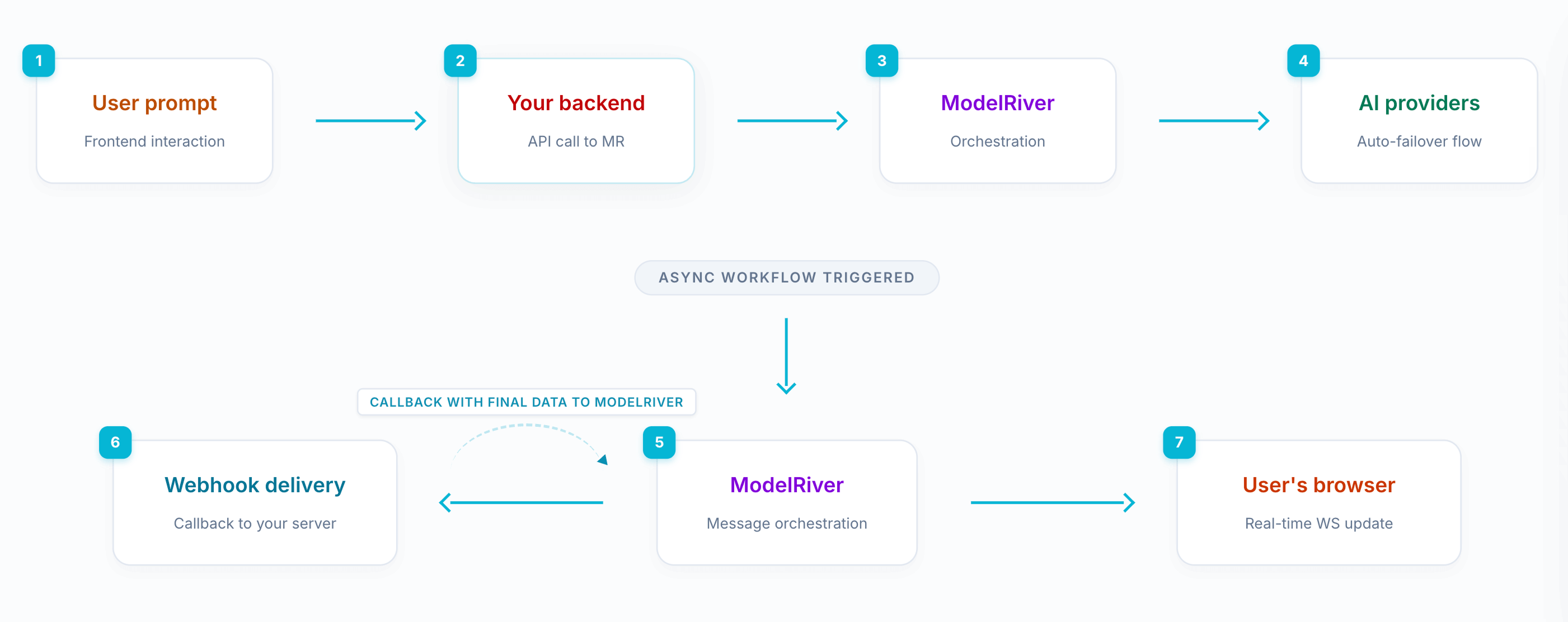
Instead of waiting synchronously for an AI response, you:
- Fire an async request.
- Let ModelRiver process the AI in the background.
- Receive the result via webhook.
- Run custom backend logic.
- Send the enriched data back using a callback URL.
- Stream the final result to the frontend in real time.
The system becomes a lifecycle, not a function call.
Yes --- webhooks add moving parts. We handle retries, verification, and observability so you don't have to.
A realistic failure example
Imagine the AI returns malformed JSON.
Your backend validates the structured output and rejects it.
Instead of:
- Crashing the request
- Sending corrupted data
- Leaving the user hanging
The lifecycle becomes:
- AI generation completes.
- Backend validation fails.
- Backend sends structured error via callback.
- WebSocket broadcasts a friendly error message to the user.
The user sees a clean failure state --- not a broken UI.
That is architectural resilience.
The three-step backend pipeline flow
Each part has a clear responsibility:
- AI generation
- Backend processing
- Real-time delivery
They are no longer tightly coupled.
Why backend pipeline architecture matters
Non-blocking by design
Frontend requests never wait for:
- AI execution
- Backend processing
- External API calls
Everything is asynchronous.
Custom logic before delivery
You control what users see.
- Validate
- Enrich
- Transform
- Store
- Reject
Before the result reaches the UI.
Reliability and retries
Backend pipeline workflows allow:
- Webhook retries
- Timeout handling
- Failure visibility
- Safe callback confirmation
You gain reliability without complex glue code.
Full observability
Every step is logged:
- AI request
- Webhook delivery
- Backend callback
- Final broadcast
Instead of guessing where a failure happened, you see exactly which lifecycle step failed.
When to stay synchronous
Backend pipeline architecture is powerful --- but not always necessary.
You may stay synchronous if:
| Scenario | Why synchronous is fine |
|---|---|
| Prototypes | Speed matters more than architecture |
| < 3s latency critical flows | Extra lifecycle steps may add overhead |
| Simple RAG chat | No backend enrichment required |
| Low traffic apps | Complexity may not justify async orchestration |
Start simple. Evolve when production demands it.
Backend pipeline vs streaming + background jobs
Some teams attempt to solve production issues by:
- Streaming tokens directly to the frontend
- Running background jobs for persistence
That works --- to a point.
But it often leaves gaps:
- No unified lifecycle
- Harder retry coordination
- Limited observability
- Scattered failure handling
Backend pipeline architecture centralizes:
- Execution
- Processing
- Delivery
- Visibility
Instead of patching reliability onto streaming, it builds reliability into the flow itself.
The bigger architectural shift
AI is not just inference.
It is:
- Workflow orchestration
- State management
- External dependency handling
- Cost-sensitive execution
- Real-time distribution
Once you model AI as a backend pipeline lifecycle instead of a blocking function call, your system becomes modular instead of fragile.
That shift is what separates demo AI from production AI.
Next steps
- https://modelriver.com/docs/backend-pipeline
- https://modelriver.com/docs/webhooks
- https://modelriver.com/docs/client-sdk
- https://modelriver.com/docs/observability/timeline
- https://modelriver.com/docs/api/endpoints
If you're building AI-powered products in production, backend pipeline architecture gives you control, reliability, and real-time delivery without unnecessary complexity.