
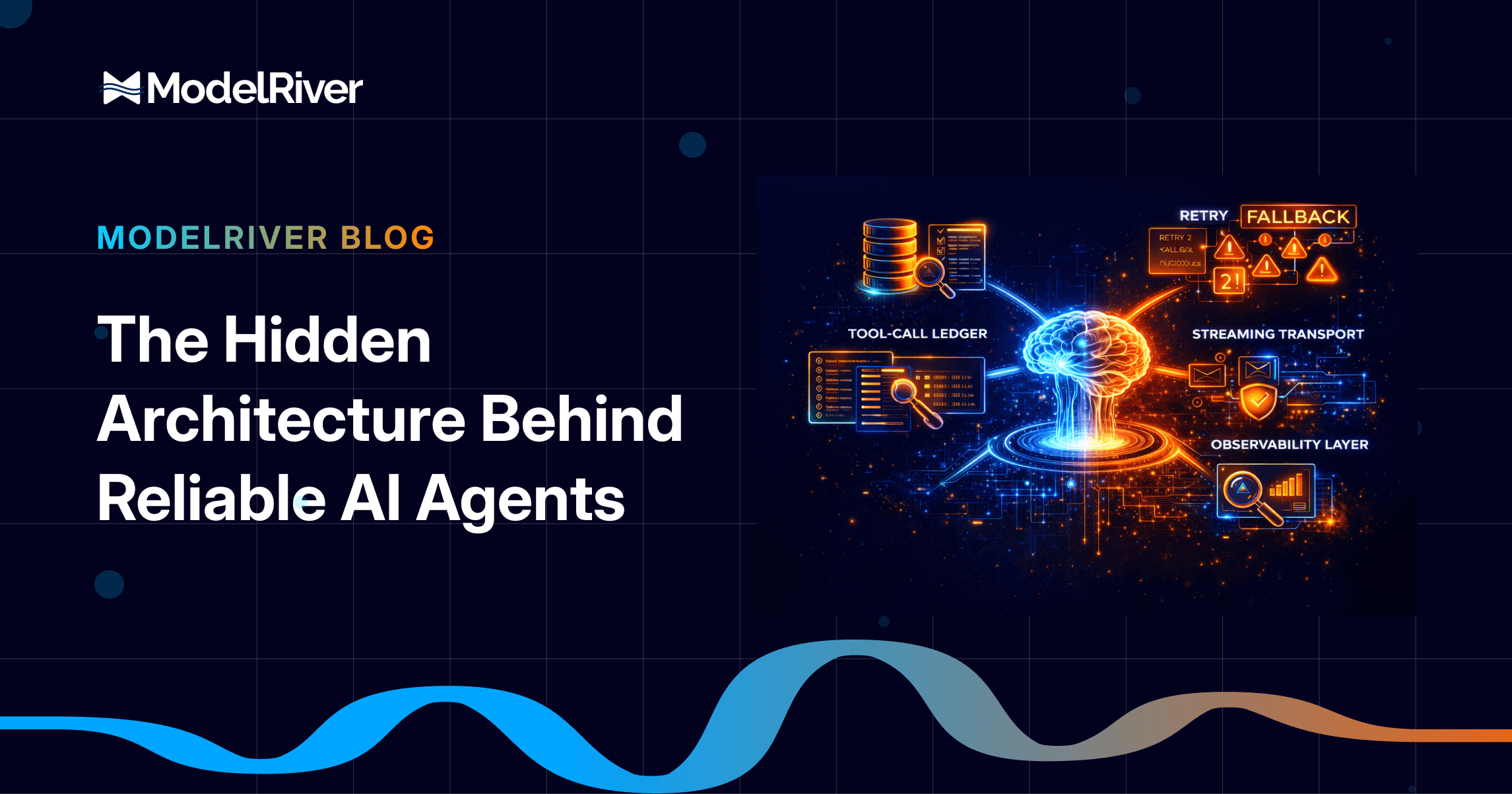
The parts nobody demos
Every AI agent demo shows the same thing: a prompt goes in, a response comes out, the audience claps. What nobody shows is the infrastructure underneath that makes it work when the demo becomes a product handling ten thousand requests a day.
I've spent the last year building that infrastructure. Not the agent logic — the layer beneath it. The routing, the failover, the caching, the rate limiting, the billing, the key management. The decisions that don't make good slides but determine whether your system survives its first month in production.
This post is about those decisions. Not theory. Not abstractions. The actual architectural choices you have to make when you're responsible for keeping AI calls alive for real users.
Decision 1: Treat every provider as unreliable
The first production lesson that hits every AI team: providers go down. Not in dramatic, site-wide outages — in subtle, partial degradations that are far harder to handle.
A model starts returning 500s for 12% of requests. Latency spikes from 800ms to 6 seconds for a specific model variant. Rate limits tighten without warning because another customer on the same tier is hammering the API.
The naive approach is to pick a provider and hope for the best. The production approach is to architect your system so that no single provider failure can take down your application.
What this looks like in practice
You need a provider chain — an ordered list of fallbacks that the system evaluates automatically:
This sounds simple until you confront the edge cases:
-
What counts as a failure? A 500 is obvious. But what about a 200 response with an empty body? A response that took 12 seconds? A response where the model returned valid JSON but ignored half the system prompt? You need to define your failure taxonomy carefully, because everything that isn't caught by your failover logic becomes a silent production bug.
-
How do you handle state across retries? If the failed call was the second step in an agent chain, does the retry include the accumulated context from step one? If you're caching the conversation history, does the retry get the same cache entry or a fresh one? These questions sound pedantic until you're debugging a production issue where retried requests produce different results because the context was stale.
-
How do you prevent cascading failures? If Provider A is degraded and you're failover-ing everything to Provider B, you might overwhelm Provider B's rate limit. Now both providers are failing. You need backpressure or circuit-breaking, not just a fallback list.
The key insight: failover isn't just a retry loop. It's a decision tree with timeout budgets, failure classification, and load distribution awareness.
Decision 2: Cache at the prompt level, not the response level
Traditional caching — store the response, return it for identical requests — doesn't work well for LLM calls. The same prompt can legitimately produce different responses (that's the point of temperature > 0), and most agent prompts include dynamic context that makes exact-match caching nearly useless.
The more useful caching layer operates at the prompt prefix level.
How prompt caching actually works
Most major providers now support some form of prompt caching where long system prompts or few-shot examples that remain constant across requests are cached server-side. The first request with a given prefix pays full price. Subsequent requests with the same prefix get a significant discount — sometimes 50-90% reduction in input token costs.
But taking advantage of this isn't trivial:
The architectural decision: you need to structure your prompts so the cacheable portion is stable and deterministic. That means:
-
Separate static and dynamic content. Your system prompt, tool definitions, and few-shot examples should live in a stable prefix. User-specific context goes at the end.
-
Hash and track cache hit rates. If your cache hit rate drops, something changed in your prompt construction pipeline. Maybe a timestamp snuck into the system prompt. Maybe a developer reordered the tool definitions. You need to detect this, because the cost difference between cached and uncached is significant at scale.
-
Be aware of provider-specific caching semantics. Anthropic's prompt caching works differently from OpenAI's. TTLs vary. Minimum prefix lengths vary. If your system routes across providers (and it should — see Decision 1), your caching strategy needs to account for these differences.
At scale, prompt caching can reduce your LLM costs by 40-60%. But only if your architecture supports it. Bolting it on after the fact usually means restructuring every prompt in your system.
Decision 3: Isolate requests at the project level
This is the decision that feels like overkill during development and becomes essential within the first week of production.
When you have multiple AI features — maybe a chatbot, an internal summarizer, and a content moderation pipeline — running through the same infrastructure, you need hard isolation between them. Not just for organization, but for safety.
What isolation actually means
-
Separate API keys per project. If the chatbot's API key leaks, you can rotate it without touching the summarizer. If the moderation pipeline has a runaway cost issue, you can kill its key without affecting the chatbot. This isn't optional. Shared keys across features is a security and operational nightmare.
-
Per-project rate limits. Your chatbot might need 100 requests per minute. Your summarizer might need 10. If they share a single rate limit pool, the chatbot can starve the summarizer during traffic spikes. Per-project limits let you allocate capacity based on actual needs.
-
Per-project cost tracking. "How much does our AI spend?" is the wrong question. "How much does our AI spend per feature, per customer tier, per use case?" is the right one. If you can't answer that, you can't make informed decisions about pricing, optimization, or which features to cut when the budget gets tight.
-
Per-project provider configurations. Your chatbot might need GPT-4o with a Claude fallback. Your summarizer might work fine with GPT-4o-mini. Your moderation pipeline might need a specific model that handles content classification well. Each project should have its own provider chain without affecting the others.
The architectural pattern: treat each AI feature as an independent tenant, even if they're all in the same codebase. The overhead is minimal. The operational benefit is enormous.
Decision 4: Meter usage, don't just count it
Every AI system needs billing or at least cost tracking. The simplest approach is to count requests. The production approach is to meter actual consumption.
Why request counting isn't enough
Both are "one request." Charging the same for both is either leaving money on the table or overcharging your smallest users. Neither is sustainable.
Token-based metering is more accurate but introduces its own complexity:
-
Different models have different pricing. GPT-4o costs roughly 15x more per token than GPT-4o-mini. If your users can choose models, your billing system needs to track which model handled each request.
-
Cached vs. uncached tokens are priced differently. If your system uses prompt caching (Decision 2), the cached input tokens cost significantly less. Your billing system needs to distinguish between cached and uncached usage, or you'll over-bill users who benefit from caching.
-
Failover changes the cost equation. If a request fails on Provider A and succeeds on Provider B, which provider's pricing applies? What if Provider B is more expensive? Do you charge for the failed attempt's tokens? These edge cases need explicit decisions, not afterthoughts.
The metering architecture needs to be backend pipeline. Every request completion emits a usage event with: model, provider, input tokens, output tokens, cached tokens, latency, and success/failure. A downstream billing system aggregates these events into billable units. This decoupling is critical because billing logic will change — pricing tiers, volume discounts, free tier limits — and you don't want that logic entangled with your request routing.
Decision 5: Encrypt secrets at the application level
Most teams store API keys in environment variables and call it a day. That works for a single-developer, single-provider setup. It does not work when:
- Multiple team members need access to different keys
- Keys need to be rotated without redeploying
- You're storing customer-provided API keys (for bring-your-own-key scenarios)
- You need audit logs of key usage
The vault pattern
The production approach is application-level encryption with a dedicated secrets manager:
-
Keys are encrypted at rest using a master key managed by a cloud KMS (AWS KMS, GCP KMS, etc.). The application never stores plaintext keys in its database.
-
Keys are decrypted only at request time and held in memory only for the duration of the API call. They're never logged, never serialized to disk, never included in error reports.
-
Key rotation is a data operation, not a deployment. You update the encrypted key in the database. The next request uses the new key. No redeploy required.
-
Access is scoped. A project's API key is only accessible to requests authenticated against that project. Cross-project key access should be architecturally impossible, not just policy-prohibited.
This adds complexity, but the alternative — a production incident where API keys are exposed in logs or error messages — is far worse.
Decision 6: Make async a first-class citizen
The traditional request-response cycle breaks down for AI workloads:
- LLM calls take 1-15 seconds depending on model and input size
- Agent chains multiply that by the number of steps
- Users expect responsiveness even when the underlying work is slow
The temptation is to make everything synchronous and add streaming on top. That works for simple chatbots. It fails for anything more complex.
The backend pipeline alternative
Instead of the frontend waiting for the full AI pipeline to complete:
This pattern has cascading benefits:
-
Timeouts become manageable. The frontend isn't holding an HTTP connection open for 15 seconds. The backend can take as long as it needs.
-
Retries are invisible to the user. If a provider fails and the system retries on a fallback, that happens in the background. The user sees a slightly longer wait, not an error.
-
Backend logic can run between generation and delivery. Validate the output. Enrich it with database data. Run content moderation. Filter PII. All before the user sees anything.
-
Multiple consumers can subscribe. The same AI completion event can trigger a UI update, a database write, an analytics ping, and a Slack notification. Without the frontend needing to know about any of it.
The trade-off is complexity. You need message queues or event buses, idempotency guarantees, and careful handling of out-of-order events. But for production AI systems, the complexity pays for itself within the first month.
Decision 7: Observe requests, not just metrics
Dashboards tell you what happened. Request logs tell you why.
The difference becomes starkly clear when you're debugging a production issue at 2am. Your dashboard says "p99 latency spiked to 8 seconds." Great. But which requests? Which model? Which step in the agent chain? Was it a provider issue or a prompt issue? Did failover kick in? Did caching help?
What production-grade observability requires
-
Per-request timelines. Not just "this request took 3.2 seconds," but a breakdown: 200ms for prompt construction, 2.8 seconds for the LLM call (including a failed attempt at 1.1 seconds and a successful retry at 1.7 seconds), 200ms for response processing.
-
Request and response body logging (with the ability to disable it). When an agent produces a wrong answer, you need to see the exact prompt that was sent and the exact response that came back. Token counts and latency alone don't explain behavioral bugs.
-
Correlation across agent steps. If an agent makes four LLM calls per user request, you need a way to group those four calls together and inspect them as a unit. Without this, debugging an agent is like debugging a distributed system without trace IDs — possible, but miserable.
-
Filterability. By model, by provider, by time range, by latency threshold, by error type, by workflow name, by custom metadata. When you have thousands of requests per hour, the ability to narrow down to the specific requests that matter is the difference between a 5-minute fix and a 2-day investigation.
The common mistake is building metrics dashboards first and adding request-level observability later. Invert that. Start with per-request visibility. Aggregate metrics are easy to derive from individual request data. The reverse is not true.
Decision 8: Design for model migration from day one
This is the decision that most teams skip and then deeply regret.
The LLM landscape changes every few months. New models launch. Existing models get deprecated. Pricing shifts. Performance characteristics evolve. If your application is tightly coupled to a specific model or provider, every model change becomes a cross-team project.
You might also like: Top LLM frameworks of 2026
What migration-ready architecture looks like
-
Your application code references logical model names, not provider-specific identifiers. Instead of
gpt-4o-2024-08-06, your code references a workflow name likeclassifyorsummarize. The mapping from workflow to model lives in configuration, not code. -
Provider-specific prompt adjustments are handled at the routing layer. Different models have different system prompt formats, tool-calling conventions, and response structures. These translations should happen in your AI infrastructure layer, not scattered across your application code.
-
Model changes are configuration changes, not code changes. Want to switch your summarizer from GPT-4o to Claude 3.5 Sonnet? Update the workflow configuration. No code review required. No deployment needed. The new model takes effect immediately.
-
A/B testing between models is operational, not developmental. Route 10% of traffic to the new model, compare quality and cost, then gradually shift. This should be a toggle, not a feature branch.
The upfront investment is small: an indirection layer between your application code and the LLM provider. The long-term value is enormous. When GPT-5 launches and you want to evaluate it, the migration time should be measured in minutes, not sprints.
The pattern underneath
If you look at these eight decisions together, a pattern emerges: the hard problems in production AI aren't AI problems. They're infrastructure problems.
Failover is a load balancing problem. Caching is a systems problem. Isolation is a multi-tenancy problem. Billing is a backend pipeline architecture problem. Secrets management is a security problem. Async execution is a distributed systems problem. Observability is a DevOps problem. Migration is an abstraction problem.
We solved all of these problems for databases, APIs, and microservices over the past two decades. The AI industry is solving them again, but the answers look remarkably similar.
The teams that realize this early — that production AI is mostly production infrastructure with a model call in the middle — build systems that scale. The teams that treat every AI problem as a novel AI-specific challenge end up reinventing wheels and burning through engineering time.
Where this is heading
At ModelRiver, we've built these architectural decisions into an infrastructure layer that sits between your application and LLM providers. Failover chains, prompt caching, project isolation, token-based billing, encrypted key management, async-first execution, per-request observability, and zero-downtime model migration — all handled at the routing layer so you can focus on the agent logic that actually differentiates your product.
If any of these decisions resonated, our documentation walks through the implementation in detail. Or just point your base_url to https://api.modelriver.com/v1 and make your first request — the request log alone will show you more about your LLM call than your current setup probably does.